


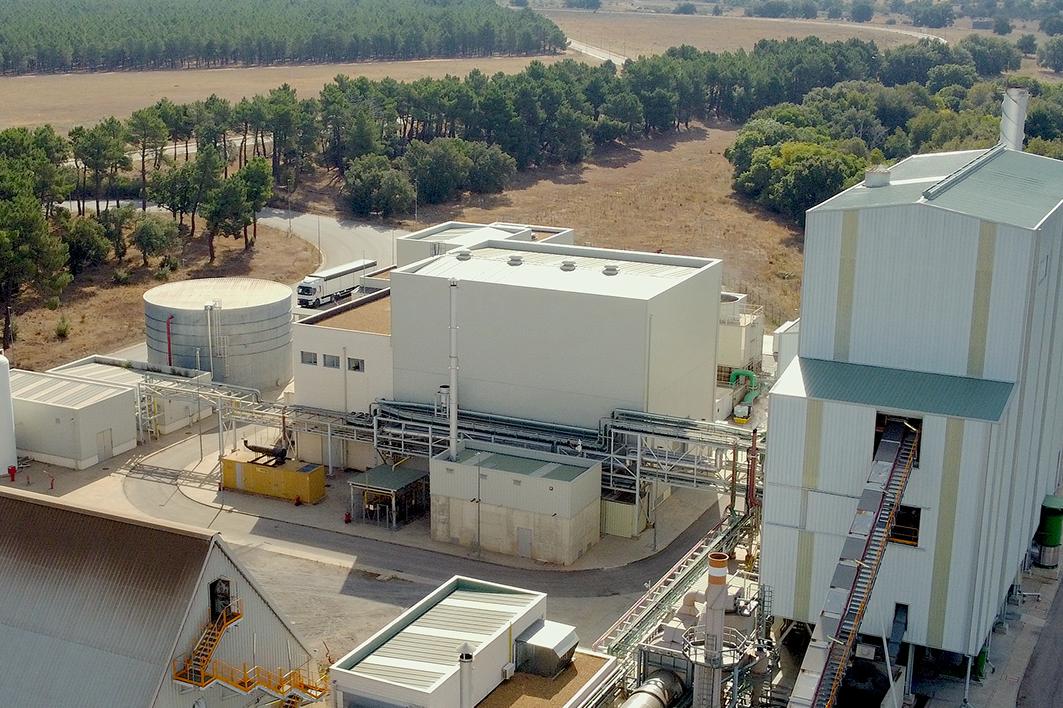
The energy recovery of industrial waste consists of taking advantage of certain waste or non-recyclable by-products as a primary energy resource to generate heat, process steam or electricity. When the material recovery of a waste is not technically viable or priority within the waste management hierarchy, this process allows it to be integrated into the energy matrix of the plant, reducing the consumption of fossil fuels, reducing the energy bill and eliminating management costs and external pour.
What you need to know about energy recovery:
- The energy recovery recovers the energy content of those wastes or by-products whose recycling material is not viable, turning a management liabilities into an energy resource.
- It ranges from forest remains and sawdust from the wood industry to agro-industrial by-products (orujillo, husks, bones), shells and sludges with adequate calorific power.
- Technical feasibility depends on the strict analysis of the lower calorific value (PCI), humidity, percentage of ash, granulometry and contaminants (chlorides, sulfur, metals).
- Depending on the type of residue and the energy vector needed, direct combustion in boiler, gasification (obtaining syngas), high-efficiency pyrolysis or cogeneration.
- Through the ESE model of ENSO, Plants can design, build and operate energy recovery facilities without providing initial capital, financing the asset with fuel savings and waste management.
What is the energy recovery of waste?
The energy recovery of waste is the use of the thermodynamic content of non-recyclable by-products or waste for the generation of useful energy. It differs from elimination (incineration in the landfill without recovery) because it reintroduces the caloric value of the residue in the production cycle, reducing the purchase of natural gas or fuel oil from the plant.
Key concepts in energy recovery
- Residue: substance or object from which its possessor detaches or has the intention or obligation to detach.
- By-product: Matter resulting from a production process whose primary purpose is not that production, but can be used directly without a complex previous transformation.
- Waste Derivative Fuel (CDR): solid biofuel or liquid formulated and homogenized from non-hazardous waste to reach stable parameters of PCI and humidity.
- Difference versus removal: Elimination destroys the residue through combustion without useful energy use, while valorization replaces primary commercial energy inputs.
How does the energy recovery of industrial waste work?
The technological process to convert a waste into an energy vector is executed in five fundamental stages:
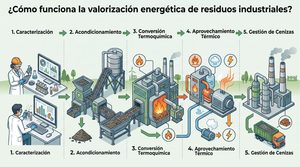
1. Identification and characterization of the residue
The physicochemical composition of the resource is audited: percentage humidity, upper and lower calorific value, ash content, ash melting point, volatility and the presence of halogenated or metals.
2. Preparation and conditioning
Mechanical processing of the residue to adapt it to the conversion chamber by crushing, chipping, thermal drying, improper screening and storage in automated feeder silos.
3. Conversion of waste into energy
Transformation of the resource through direct thermal reactions (combustion in a grid or fluidized bed) or thermochemical (gasification to produce biogas of synthesis or pyrolysis for biochar and bio-oils).
4. Use of the energy generated
Transfer of the heat released in the chamber to process fluids in the form of saturated/overheated water vapor, hot water, thermal oil or steam for cogeneration turbines.
5. Management and valorization of by-products
Treatment and purification of exhaust gases in accordance with the emission limits, together with the collection and valorization of bottom ash and flywheels (for example, for their incorporation into construction materials or agricultural amendments).
What industrial waste can be energy-relieved?
The technical feasibility does not depend on the name of the waste, but on its constant physicochemical and logistics availability in the industrial environment:
- Waste of forest and agricultural origin: Remains of pruning, forest clearings, straw, vines and stubble of agricultural biomass.
- Agro-industrial by-products: Olive pomace, dried fruit peel, olive bone, grape pomace or bagasse of cane and beer.
- Waste from the wood industry: Bark, chips, sawdust, chips, cuts and woody rejections of first and second wood transformation.
- Organic waste with energy potential: Pre-drying industrial sewage sludge (EDAR), food processing waste, or digestates.
- Specific industrial by-products: Paper rejects (rejection of woody/cellulose pulper) or non-mechanically recyclable textile waste.
- Ashes and slag from the combustion of biomass allows the manufacture of mineral fertilizers or Sustainable building materials SUBSTITUTE OF THE ZAHORRA
In order for the valorization to be stable, it is essential to analyze the technical characterization of solid biofuel in parameters of humidity, granulometry and chlorides, ensuring the continuity of the supply of Industrial biomass.
What is the difference between energy recovery and recycling?
European and Spanish environmental legislation (Waste Law 7/2022) sets a clear management hierarchy where recycling raw material on energy recovery:
Parameter | Material recycling | Energy recovery |
Recovery | Recover the material to manufacture new products | Recovers energy content (heat/MWh) |
Hierarchy | Top priority when it is technically and economically viable | Secondary priority for non-recyclable fractions |
Process | Physical/mechanical transformation of polymers, metals or paper | Thermochemical conversion (combustion, gasification, pyrolysis) |
Example | Plastic recycling for pellets or cardboard for pasta | Steam generation with agro-industrial by-products |
What technologies are used to recover energy waste?
The type of thermal reactor depends on the humidity, granulometry and temperature required in the plant:
Direct combustion
Complete high temperature oxidation process (800-1,100ºC). It is made by mobile grill boilers (suitable for residues with heterogeneity of variable size and humidity) or fluidized bed boilers (for fine resources with complex ash), producing direct process steam.
Gasification
Thermochemical conversion into a substoicyometric atmosphere (oxygen defect) that transforms the solid residue into a fuel gas. It allows to feed internal combustion engines, gas turbines or directly replace natural gas in existing burners.
Pyrolysis
Thermal degradation of the residue in the total absence of oxygen at medium temperatures (400-600ºC). It decomposes the resource into three usable fractions: a liquid fraction (thermal bio oil), a gaseoussyngas) and a solid (Biochar or biochar).
Cogeneration with biomass and residues
Combined use of the energy of the waste to simultaneously generate electricity and useful process heat. If you want to delve into this type of integrated solutions and their advantages, we recommend you to consult our section on High efficiency cogeneration.
How to know if an industrial waste can be energetically valued?
A pre-feasibility study should holistically validate the following factors:
- Analyze the lower calorific value: The residue must provide a useful minimum energy density (values greater than 11-13 MJ/kg are recommended on a base as it is).
- Determine the humidity: Humidities greater than 50% drastically reduce the flame temperature and require previous processes of drying with residual heat.
- Analyze ashes and melting point: Ashes with a high potassium or sodium content reduce the melting temperature, generating slag or ash problems in the boiler tubes.
- Assess contaminants (chlorine and sulfur): High chlorine levels (Cl > 0.1%) accelerate high temperature corrosion and require advanced gas purification systems.
- Check volume and logistic continuity: Ensure stable tonnage throughout the year to amortize the reactor investment.
- Validate the regulatory framework: Accredit whether the resource is legally classified as a by-product or as a waste subject to the Industrial Emissions Directive.
How to implement a step-by-step energy recovery project?
The development of an industrial energy recovery plant is executed in nine structured phases:
- Step 1. Identify waste and by-products: Internal audit of volume and seasonality of waste produced or available in the local environment.
- Step 2. Characterize the resource: Laboratory analysis Certified PCI, humidity, ash, granulometry and elementary composition.
- Step 3. Analyze the factory energy demand: Map the thermal load curve (tonnes/hour of steam, pressure and temperature) and power consumption of the plant.
- Step 4. Select conversion technology: Choose between combustion on the grill, fluidized bed, gasification or pyrolysis according to the sheets of the residue.
- Step 5. Design energy integration: Define the hydraulic, electrical and control interconnection with the pre-existing installations of the factory.
- Step 6. Analyze economic viability (Capex/Opex): Study the financial balance by adding the replaced fuel savings, the savings in avoided landfill fees and the operating costs of the system.
- Step 7. Process permits and environmental authorizations: Obtaining the integrated environmental authorization (AAI) or modification of the activity license.
- Step 8. Electro-mechanical construction and assembly: Execution of civil works, installation of boilers, silomotors, cyclones, filters of sleeves and fireplace.
- Step 9. Commissioning, operation and optimization: Combustion calibration, thermal reception tests and continuous operation.
What are the benefits of energy recovery of industrial waste?
- Reduction of fossil fuel consumption: Direct replacement of natural gas, propane or fuel oil by an indigenous thermal resource.
- Savings in waste management costs: Elimination of transportation fees and discharge fees paid to external managers.
- Autonomy and energy resilience: Decrease in the vulnerability of the factory in the face of the volatility of the prices of the hydrocarbon market.
- Direct advance in decarbonisation: Replace fossil gas with residual biomass or organic by-products eradicates direct CO2 emissions from scope 1. If you want to analyze the global financial return of these strategies, we recommend you to consult the Economic benefits of industrial decarbonization.
- Integration in circular economy: Reorganization of the production model where the unwanted by-products of a process are converted into the energy that feeds the next manufacturing cycle.
What industrial waste can be used to generate heat and steam?
In the manufacturing industrial sector, the generation of process heat from biomass valorization is primarily concentrated in:
Agricultural and agro-industrial by-products
Dry pomace in the olive industry, almond or pine nut shells, raven pomace and rice husks. They provide high PCIs and stable energy densities for saturated steam boilers.
Forest waste
Woody wood from clearing of clearings, cups and branches with no timber value, low environmental footprint and high regional availability.
By-products of the wood industry
sawdust, chip, cutouts and clean splinter generated in sawmills and furniture factories, offering low humidity and highly clean combustion.
How is energy recovery integrated in an industrial plant?
The valuation facility is not conceived as an isolated module, but as a hydraulically and thermally integrated custom solution in the factory:
- Steam generation for processes: Direct interconnection to the steam collecting network that feeds reactors, dryers or distillation columns.
- Production of hot or overheated water: Closed thermal circuit for auxiliary circuits of pasteurization, washing or industrial heating.
- Thermal oil generation: For high-temperature reactor coils and presses (>280-300°C) at low working pressure.
- Renewable cogeneration: Installation of steam turbines or gas engines that generate both process steam and regulated electricity. To understand the normative opportunities of this scheme, you can review the keys of the Cogeneration Auctions 2026-2027.
What factors determine the profitability of an energy recovery project?
The economic viability of a project is not measured solely by comparing the cost of the waste against the price of gas; It requires evaluating the total cost of ownership equation:
Profitability = F (substituted gas savings + avoided cost – CAPEX/OPEX – Logistics)
- Availability and logistics radius: The closer the waste is to the point of consumption, the lower the cost of transport per MWh.
- Useful calorific value: The higher the energy density per ton, the lower the storage and handling volume requirement.
- Previous management costs avoided: The direct savings of stopping paying an external manager for the collection or deposit in the by-product landfill.
- Annual operating hours: Installations with continuous production schemes (>6,000-7,000 h/year) Accelerate thermal equipment rapidly.
- Gas maintenance and purification costs: Consider the maintenance of refractories and the addition of reagents (lime, bicarbonate, active carbon) for emission control.
Energy recovery of waste and industrial decarbonisation: what relationship do they have?
The energy recovery of organic by-products and biomass residues is one of the most effective levers of Industrial decarbonisation. It allows the burning of fossil fuels (scope 1) to be replaced by energy derived from neutral biogenic carbon.
However, for a transition plan to be solid, energy recovery must be integrated as a complementary measure within a holistic framework document. You can consult our complete methodology to structure these actions in the guide on the Industrial Decarbonization Plan.
What challenges does the energy recovery of waste have?
To ensure the success of the installation, the project engineering must manage the following operational obstacles:
- Resource heterogeneity: Seasonal variations in moisture, composition, or particle size of the residue.
- Ash inlay and phagocytosis: Appearance of low fusion deposits in boiler tubes when by-products are burned high in sodium or potassium.
- Strict emission control: Requirement to install sleeve filters and denitrification systems to comply with legal limits of contaminants in the chimney.
- Initial investment required: Solid biofuel boilers and handling equipment require budgets higher than a conventional gas boiler.
If you want to analyze the energy recovery potential of the by-products of your plant or look for decarbonization alternatives or learn more about What is Industrial Decarbonization, Our team of engineers can develop a personalized technical diagnosis.
Frequently asked questions about the energy recovery of waste
What residues can be valorized energy?
Those that have sufficient caloric content and are not materially recyclable in a profitable way, such as forest waste, timber by-products, agro-industrial shells, pomace, dry sewage sludge or rejection cellulosics.
What is the difference between energy recovery and recycling?
Material recycling recovers waste material to manufacture new products. Energy recovery recovers its caloric content to generate heat, steam or electricity when recycling is not technically viable.
How is a waste transformed into energy?
Through a process of thermochemical conversion (direct combustion, gasification or pyrolysis) that releases the heat contained in the residue and transfers it to a working fluid (water, steam or oil) connected to the industrial process.
What technologies are used to recover waste?
The main ones are the mobile grill or fluidized bed combustion boilers, the fixed/fluidized bed gasifiers, the pyrolysis reactors and the steam cogeneration plants.
Can industrial waste be used to generate process steam?
Yes. It is the most common application in the industrial sector. Residual biomass boilers replace natural gas generating saturated or superheated steam at the pressures required by the factory reactors.
Is it cost-effective to energetically value industrial waste?
Yes. It is very profitable when two simultaneous financial savings are combined: the elimination of the cost of sending the waste to an external landfill or manager and the savings derived from buying natural gas or expensive fossil fuels.
What permissions does an energy recovery facility need?
Requires integrated environmental authorization (AAI) or the substantial modification of the environmental license of the plant, processed before the Ministry of the Environment of the corresponding Autonomous Community.
How is an energy recovery project implemented in an industry?
Starting with the analytical characterization of the waste in the laboratory, designing thermal integration engineering, processing environmental licenses and executing construction and commissioning, a process that can be 100% outsourced through an ESE model without capital outlay.

Roberto Díaz Cantarero is the Chief Business Development Officer (CBDO) at ENSO. Specializing in business development, the energy transition, and sustainable solutions for the industrial sector, he brings his expertise in process decarbonization and the implementation of bioenergy and energy efficiency projects.